Gambling AML checks: what continues after KYC?
Turn a new account alert into a reasoned review, with evidence, a named decision-maker and a follow-up point.
Short answer
- After onboarding, compare player and payment-account details, transactions and activity; review or refer internally to compliance by risk, record why, and separately assess local reporting duties.
- A new alert does not automatically require a freeze or report; FATF indicators need context and local legal analysis.
- Great Britain’s withdrawal-information rule and Australia’s ongoing CDD framework have different scopes; neither supplies a global workflow or deadline.
Start with changes since the last review: account details, transaction patterns and play that no longer fit the information already held. Completing KYC is the starting point for this workflow, not a permanent clearance.
Check what changed after onboarding
Here, “daily checks” means an operational review routine, not a claim that every jurisdiction requires every account to be manually reviewed once a day. The appropriate frequency and response depend on the applicable rules and risk. This guide concerns player accounts, not the company documents assembled for a licence application.
Follow one fictional alert from evidence to decision
Start by establishing what changed, rather than treating the alert as a conclusion. The following example and record format are WHY’s internal-workflow suggestions, not an official checklist or a real customer case.
Player A passed onboarding checks. A later deposit arrives from an account displaying a different name; activity also differs from the player’s previous pattern. The reviewer has not yet established whether the name is a display error, an authorised account arrangement or a third party. None of those explanations should be assumed.
The reviewer compares the existing identity record, account details and transaction history, then identifies the specific gap that needs resolving. If available evidence does not resolve it, the case goes to the designated compliance decision-maker with the unresolved facts clearly marked. A new alert alone does not determine whether funds must be frozen or a report filed.
| Internal record | Synthetic example |
|---|---|
| Trigger time | Day 1, 09:10: account-name mismatch and changed activity detected. |
| Evidence | Existing identity record, displayed account name and relevant transaction/activity history; ownership remains unconfirmed. |
| Reason | Explain why the mismatch matters and which possible explanation remains untested. |
| Decision and owner | Assigned compliance reviewer determines proportionate next steps and separately considers applicable reporting duties; record who decided and why. |
| Next review | Set an owner and a risk-appropriate follow-up point; record new evidence and whether it resolves the concern. |
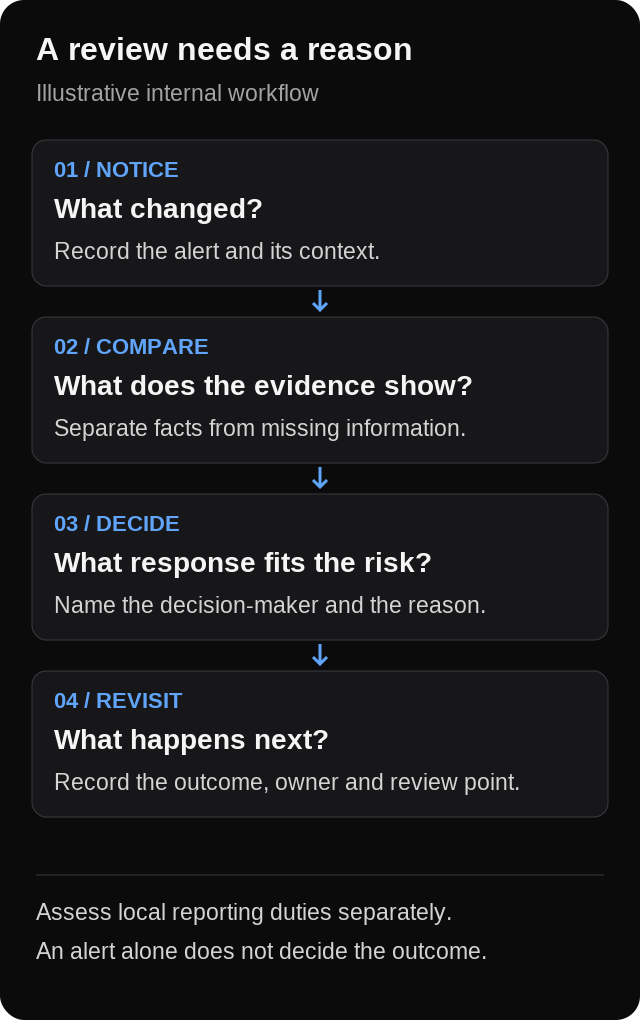
The diagram illustrates our proposed internal workflow. It does not prescribe automatic account restrictions, reporting thresholds or a universal deadline.
Use risk indicators to ask better questions
An indicator calls for context, not a finding of wrongdoing. FATF’s September 2026 report lists account changes, patterns inconsistent with a customer profile, and transaction anomalies across printed pages 6 and 8–9. Its introductory caution says indicators vary in relevance and may also overlap with gambling harm. They are risk indicators, not universal legal obligations. FATF report
In the fictional case, the useful question is what evidence explains the change. A checklist that only records “KYC passed” or “below threshold” leaves that question unanswered. Keep fraud, player-protection and AML assessments distinguishable even when they use some of the same evidence.
Great Britain: verify before gambling and avoid deferred withdrawal checks
For the remote licences within its scope, UKGC condition 17.1.1 requires identity verification before gambling. It includes ancillary telephone/email betting; exclusions cover qualifying low-frequency/subscription-only lottery licences, gaming machine technical, gambling software, host, ancillary remote casino and ancillary remote bingo licences. Consult the condition for the exact scope. LCCP 17.1.1
A withdrawal cannot be made conditional on information the operator could reasonably have requested earlier. Information required at that time by another legal obligation remains an exception. An internal policy does not itself create that additional legal obligation. This is not a blanket prohibition on later enquiries. LCCP 17.1.1, paragraph 2
The 21 October 2026 L & L Europe regulatory settlement illustrates two separate failings: withdrawals were delayed by manual reviews that required some information which could reasonably have been requested earlier; separately, AML controls relied too heavily on financial thresholds and sampling instead of customer risk. Do not collapse those findings into a rule to stop every unusual withdrawal. UKGC statement
For the separate distinction between software supply and hosted gameplay permissions, see our Great Britain B2B licensing guide.
Australia: investigate the context and document the response
AUSTRAC’s guidance for entities subject to Australia’s AML/CTF framework calls for risk-appropriate responses to unusual activity, including review of existing information, internal referral to compliance where appropriate and a record of the reasoning. Unusual activity is not necessarily illegal; suspicious matter reporting requires a separate assessment against the applicable legal grounds. AUSTRAC ongoing CDD guidance
On 6 July 2026, AUSTRAC announced a legally binding enforceable undertaking for bet365 to improve its AML systems, including ongoing risk assessment and detection/reporting capability. That undertaking concerns the named business; it is not a new worldwide rule. AUSTRAC announcement
Australian licensing scope is a separate question, covered in our Australia wagering guide.
Make the next review possible
Leave a record that another reviewer can follow: the trigger, evidence considered, missing information, decision-maker, reason and next review point. If the concern is resolved, record what resolved it; if it remains open, name the person responsible for the next step.
Before turning this example into a procedure, map it to the operating entity, licensed activity and local rules. Withdrawal handling, customer enquiries and reporting decisions need their own legal assessment. This guide sets neither a global reporting deadline nor a monetary trigger.
Official sources
- UKGC — LCCP 17.1.1www.gamblingcommission.gov.uk
- UKGC — L & L Europe regulatory settlementwww.gamblingcommission.gov.uk
- AUSTRAC — Responding to unusual transactions and behaviourwww.austrac.gov.au
- AUSTRAC — bet365 enforceable undertakingwww.austrac.gov.au
- FATF — Risks of Gaming and Gambling, September 2026www.fatf-gafi.org
Checked on 24 Nov 2026. Rules, fees and forms change; confirm the current position before acting.